Building Industry Relations: Rose-Hulman Capstone Projects
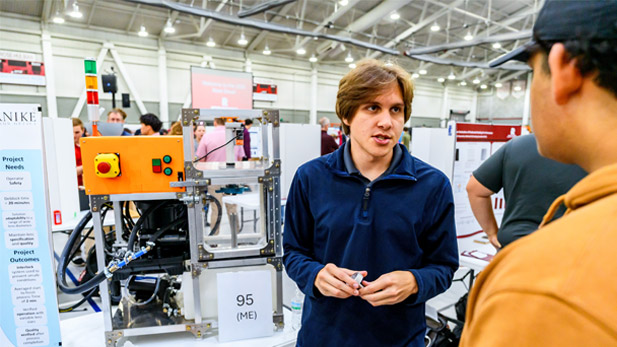
Paired with industry clients, Rose-Hulman students solved company challenges through their design, capstone, and Rose Show projects.
Rose-Hulman students and graduates are renowned for their problem-solving capabilities and their contributions to their companies, many of which start long before they graduate. As the final culmination of a Rose-Hulman education, senior capstone and Rose Show projects require students to take the lead on decisions related to scope, budget, and design to fulfill an industry need.
Through programs such as the recently launched Rose-Hulman Design Clinic, student teams representing several academic departments match with company clients to solve real industry challenges or bottlenecks, exploring ideas that the organization lacks adequate resources or expertise to develop on their own.
Two Six Automated Assembly
Electrical & Computer Engineering
Nicholas Douglas, Owen Macrowski, Eliana Baker, Sean Rody
This project developed an autonomous manufacturing system capable of performing component pick-place and screwdriving operations for Two Six Technologies. The team conducted an extensive market survey to evaluate potential solutions based on technical feasibility and return on investment, ultimately selecting the Universal Robotics UR5e and OnRobot end-of-arm tooling. Using a custom manufacturing jig, the robotic arm accomplishes key tasks such as placing a printed circuit board into its housing, positioning the lid, and fastening four screws to complete the assembly. This solution elevates the client's manufacturing capabilities from one-off products to small-scale integration.
"One of the cool things about this robot is that it's a collaborative style robot, which just means it's safe to work around and in the environment," said Eliana Baker, a 2026 electrical engineering graduate.
Milwaukee Tool Trigger Optimization
Multidisciplinary Design
Henry Faris, Jimin Park, Margo Leone
This team redesigned the safety and trigger mechanism for the Milwaukee Tool M12 Brushless Pruning Shears based on user feedback, improving the ergonomics and functionality for extended use. The team broke down the problem into a list of requirements for safety, ease of use, and user comfort in addition to physical requirements from the client, using rapid prototyping to test the designs. Each prototype was benchmarked against the requirements through multiple rounds of user testing with landscaping professionals on and off campus. The final design uses a rack and pinion system, providing the client a design platform to further improve the tool.
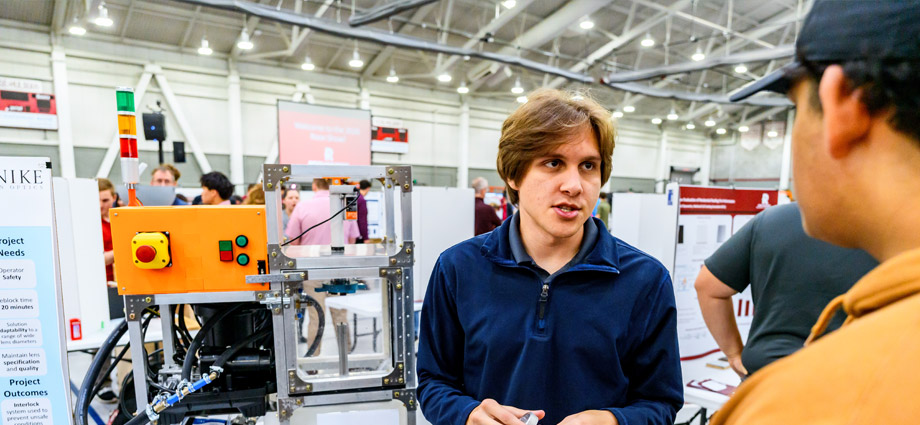
Pop Block Lens Deblocker - Zernike Precision Optics
Mechanical Engineering
Asher Blythe, Ryan Burch, Ethan Minckler, Jake Vincent, Mark Hankins
Founded by 2025 Rose-Hulman alumni, Zernike Precision Optics Inc was created to provide high-quality, custom aspheric lens more affordably and more quickly. Facing a manufacturing bottleneck, the leaders of Zernike Precision Optics knew where to turn to solve the problem — a team of Rose-Hulman students. The Pop Block project created a partially automated affordable deblock system for integration into Zernike's manufacturing process. Deblocking is a critical step in optics manufacturing, removing the resin glue lens from its fixture without causing damage to the lens. The Pop Block system significantly reduces Zernike's current deblock time while maintaining a per lens cost of less than $1.
Bearing Life Tester Expansion - thyssenkrupp Presta
Mechanical Engineering
Jamie Grace, Gabe Muller, William Prusak, Jeremiah Sweeny
This team worked with thyssenkrupp Presta to solve two different manufacturing challenges. During the first half of the year, the team created a comprehensive packaging solution for their prototyping shipping. Because they were able to find an effective solution so quickly, the team moved to a new project during winter quarter, designing upgrades to thyssenkrupp Presta Fishers' Bearing Life Tester. This project, which they presented at the 2026 Rose Show, is used for verifying steering column durability. This machine was reverse-engineered, and upgrade proposals were delivered to fulfill additional testing requirements.
Operational Technology Rehosting with Penguin - MIT Lincoln Labs
Electrical & Computer Engineering
Kunaal Tyagi, Isaac Mierow, Brooke Spurlock
Working with MIT Lincoln Laboratory, this project demonstrates a rehosted Operational Technology (OT) device connected to a simulated water tank to demonstrate a cybersecurity vulnerability. The device monitors tank parameters and responds to sensor feedback through the Modbus protocol. A malicious actor is then introduced to exploit Modbus vulnerabilities, altering data transmissions and device responses. This demonstration highlights weaknesses in common industrial communication protocols and emphasizes the importance of cybersecurity measures in protecting critical OT systems.
Mobility System for Asteroid Exploration - NASA Psyche Mission
Mechanical Engineering
Andrew Dunleavy, Anthony Hoyt, Nathan Neppl, Karis Peringson
This project aimed to develop a mobility system capable of traversing 16 Psyche, an M-type asteroid between Mars and Jupiter, for a future NASA exploration mission. Because expected features of Psyche include rough terrain, the mobility system must climb hills, navigate obstacles, and support an instrument payload. The team constructed a shuffler-type robot with independent motor actuation and functionality in various orientations.
"The whole idea is that it also has a very specific drive mechanism where, if you move the opposite corners of the shuffler bot, you can actually spin 360 degrees on your axis," said Andrew Dunleavy, a 2026 mechanical engineering graduate. "That's super useful if you're going into a crater, where you just want to turn around and you can't necessarily back up."
The full-scale model dynamics were simulated with MATLAB Simscape Multibody, accounting for the expected asteroid conditions. This project was completed in association with NASA and Arizona State University.
"When I was a freshman, my RA had a NASA capstone project. I remember…looking at his project and going, 'Wow that's a NASA project. That's so cool!'" said Dunleavy. "Three years later, I'm doing an extension of that project. It's a really exciting experience when you realize you are that person you met the first day."
Psyche Explorer: Sample Acquisition from Metallic Asteroid Surfaces
Mechanical Engineering
Adam Johnson, Abdullah Islam, Carter Kirtz, Ian Talbert
Psyche is an asteroid between Mars and Jupiter, rich in metal and hypothesized to be exposed core material of a planetesimal, a small early celestial body. Future NASA scientists may propose sending a missing to extract surface samples from Psyche, and this team's goal was to prove a novel sample extraction mechanism could offer benefits over conventional methods in the harsh mission environment. The design is a rover's end-of-arm tool (EOAT) employing an oscillating blade to cut a pyramid-shaped sample and a microspine anchoring system for stabilization.
RFEP Bonding Process - Cook Medical
Mechanical Engineering
Eathan Faust, Jayden Gibson, Erin Nolan, Tori Scales
Cook Medical required verified machine settings to bond two parts of different materials together for a sheath, which is used to introduce catheters and other medical equipment into the human body. The team provided new optimized machine settings for numerous sizes to Cook that were verified through DOEs and statistical analyses. In addition, the team created an image recognition system by creating and training an AI model to help with the quality check procedure. They also designed a processing aid for assembly workers who have reduced dexterity.
Milwaukee Tool Automated Failure Mode and Effects Analysis (FMEA)
Electrical & Computer Engineering
Ellis Lyons, Zoe Millen, Steven Reese
Milwaukee Tool develops and produces a wide range of power tools, which each require a printed circuit board (PCB) to run. After creating designs for these PCBs, a Failure Mode and Effects Analysis (FMEA) must be carried out on the circuit board.
"Failure Mode and Effects Analysis was invented by the military in the 1960s and has since been adapted to almost every industry in the world," said 2026 graduate Zoe Millen. "It's used to identify where on the circuit components could fail, how they can fail, and what the severity would be on the entire circuitry if they were to fail."
Currently, this is accomplished by manually populating an Excel spreadsheet with relevant data about the PCB components. This project significantly reduces the time PCB designers spend manually completing FMEA documentation, enabling them to prioritize other projects. In addition, the standardization of FMEA severity and the ability to detect rankings will help limit confusion for new hires.
Glassboard X Rose-Hulman Vacuum Silicone Injection Moldiing System
Multidisciplinary Design
Sid Gion, Calvin Jorgensen, Alexander Nustad, Cale Royer, Quinlan Walinder
Glassboard Product Development relies on rapid prototyping to deliver production-quality models for clients across industries, often using SLA-printed molds and two-part silicone. Their current silicone mixing and injection workflow is slowed by lengthy degassing times and inconsistent manual injection, which can trap bubbles and compromise prototype quality. This project aims to design a device that securely holds both mold and syringe, seals the syringe for degassing, and uses a controllable actuator to inject silicone under vacuum. Enclosed within a custom vacuum chamber, the system will streamline degassing, improve injection precision, and enhance prototype reliability.
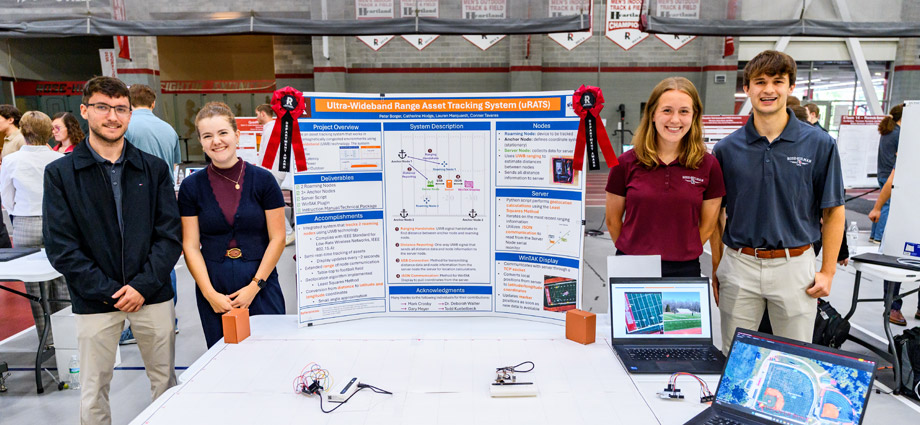
uLTRA-WIDEBAND rANGE aSSET tRACKING sYSTEM (Urats) - nswc cRANE
Electrical & Computer Engineering
Peter Borger, Catherine Hodge, Lauren Marquardt, Conner Tavares
The Ultra-Wideband Range Asset Tracking System (uRATS), sponsored by NSWC Crane, provides quasi-real-time tracking of mobile assets in areas where electromagnetic interference is high. Ultra-wideband (UWB) technology uses low-power, high-frequency, and a wide bandwidth to measure range between nodes through almost any potential interference. The uRATS system includes a server to collect range data and perform geolocation algorithms to track mobile objects and a display to show location of the mobile object on a world map that is updated approximately every second.
magnus Engineering Headquarters
Civil & Environmental Engineering
Benjamin Coons, Jadyn Winkler, Cobi Harris, Meropi Gkiouzelopoulou
Magnus Engineering is a structural engineering firm in Mishawaka, Indiana. The company specializes in the analysis and design of structural systems for a wide range of projects, emphasizing technical excellence, efficiency, and innovation. As Magnus Engineering continues to grow and expand its practice, the firm plans to relocate to a newly constructed office building that reflects both its professional identity and forward-looking vision. The new facility is intended to embody the character of the company while supporting collaboration and future expansion. At present, Magnus Engineering has purchased a site with existing development plans in place for the future headquarters. While there are buildings located in the surrounding area outside the property boundaries, the site itself is supported by existing infrastructure, including a parking lot, utility and electrical lines, and a septic system. These existing conditions provide a functional starting point for development while requiring careful evaluation to ensure compatibility with the proposed expansion and long-term operational needs. The proposed Magnus Engineering Headquarters will serve as the future home of the firm and will consist of a modern, functional, and creative 8,000-square foot office building featuring a basement, a partial second floor, and a covered outdoor patio. The architectural and structural design will reflect the company's identity through the use of exposed glue-laminated timber, composite Fiber Reinforced Polymer (FRP), and structural steel elements, accentuated by an extended entryway canopy. The interior layout will include a dedicated executive wing, a production wing for design staff, and shared spaces such as conference rooms, collaboration areas, a kitchenette, and restrooms. Site improvements will involve evaluation of the existing stormwater management system and assessment of parking lot capacity to accommodate potential future expansion. The project will be completed under the supervision and expertise of Magnus Engineering's professional staff.
Excavator Payload Estimation System - Renascent Inc.
Multidisciplinary Design
Michael Wilson, Jacob Cockerill, Toby Zhao, Connor Luce, Prithvi Vijaykrishnan
The Excavator Payload Estimation System is a loading aid designed to help excavator operators fill haul trucks to a target weight without relying on guesswork. It uses inclinometers, hydraulic pressure transducers, and a calibrated predictive model to estimate bucket payloads. By giving operators real-time feedback through an in-cab user interface, the system improves loading consistency while reducing haul trips and overweight liability.
"Our solution is novel because we require no direct measurements of the excavator," said 2026 mechanical engineering graduate Jacob Cockerill.
Learn more about the Rose Show and past projects here.