Combat Robotics Gored Competition at National Havoc Robotics League
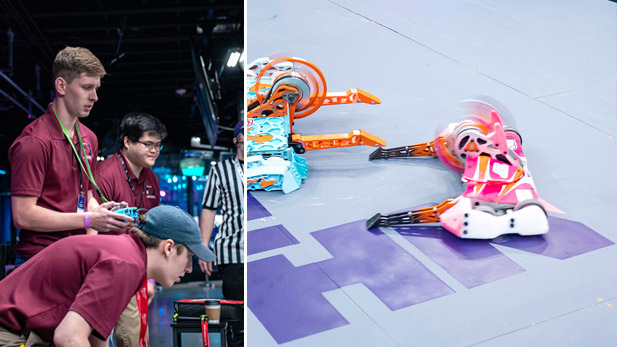
Battling against fierce competitors, Rose-Hulman's Combat Robotics team emerged triumphant from the National Havoc Robot League (NHRL)'s competition on February 7 in Norwalk, Connecticut, earning a place at two more upcoming NHRL events.
Battling against fierce competitors, Rose-Hulman's Combat Robotics team emerged triumphant from the National Havoc Robot League (NHRL)'s competition on February 7 in Norwalk, Connecticut, competing among graduate students and robotics professionals and earning a place at two more upcoming NHRL events.
Known for its quick-paced, enthralling competition, the National Havoc Robot League promotes combat robotics around the world and has signed media broadcast deals with ESPN and Cheddar. Competitive matches last 3 minutes, with robots seeking to knock out their opponent or accumulate judges' points, awarded based on aggression and damage inflicted. Robots compete in several weight classes with very few restrictions on their structure or components. Rose-Hulman's Combat Robotics team works as a unit on a 30-pound robot, splitting into small groups of two to four students to design bots for the 1-pound, 1-pound 3D printed, and 3-pound categories.
As they competed in the 30-pound class in Connecticut, their distinctive, hot pink robot, Gored — named for its ferocity in battle — brandished its whizzing weapon menacingly, knocking competitor robots into the walls of the competition space and sending sparks flying. By design, Gored prioritizes drivetrain and "ground game" — the ability to get under and control its opponent — allowing it to dominate more expensive, complex bots.
"Members frequently need to balance not only design elements like weight, function, and aesthetics, but also the cost and complexity impacts of their choices," said Ian Talbert, a senior mechanical engineering major who served as Combat Robotics president this year. "I like to think of it like product design, where you have to make all the right choices to win (or) be marketable."
Rose-Hulman's team earned a second-place finish in the 30-pound robot class field of nine, beating two teams from University of Illinois Urbana-Champaign. The finish qualified the Rose-Hulman team and Gored for both the NHRL's Pro League competition in May, as well as the NHRL Championships in December. The team is currently fundraising and seeking sponsors for the travel.
"As a smaller school and relatively new team, we often need to innovate to beat incumbents, which is reflected in our robot building doctrine," said Talbert.
One of the few bots to beat the Rose-Hulman team in a battle was built and driven by reigning national champion and 2019 mechanical engineering alumnus Peter Garnache. His monster of a machine smoked its competition, utilizing a flamethrower to engulf them in a ball of fire. Garnache, who left a design engineering role to focus on his combat robotics parts business, also won the 3-pound division in 2024.
The team, represented by Talbert; Carter Kirtz (ME, 2026); Ryan Driemeyer (ENGD, 2027); Aiden Povse (ME, 2028); and 2026-2027 president Nathan Milhorn (ME, 2028), also connected with several other alumni in attendance at the competition. Brighton Lee, a 2024 mechanical engineering graduate currently pursuing a master's degree in robotics at Worcester Polytechnic Institute, competed in another weight class, and Tristan Heartt, a 2025 mechanical engineering graduate who had originally designed Gored as part of his senior capstone project, also brought bots to battle.
Rose-Hulman's Combat Robotics is one of four teams that work as part of the Robotics Team in the Kremer Innovation Center. Open to students of all majors, the team provides to gain knowledge in materials, mechanical design, industrial design, and manufacturing methods, giving both their robots and their careers a competitive edge.
Combat Robotics’ matches can be viewed at the National Havoc Robot League’s YouTube channel.
Photos courtesy of National Havoc Robot League.