Rose Propulsion Lab Performs Hot Fire Liquid Rocket Engine Test
Thursday, June 25, 2026
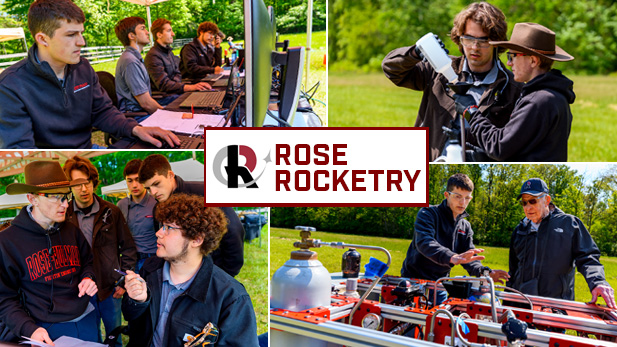
Rose Propulsion Lab students tested Rose-Hulman's first student-produced hot fire rocket engine, the culmination of years of research.
Hulman Farm, we are cleared for launch.
On a bright Saturday morning, members of Rose Rocketry's Rose Propulsion Lab (RPL) set up a miniature Mission Control on a portion of the Hulman Farm property. The students pored over monitors and measurements, making final preparations for Rose-Hulman's first-ever hot fire liquid rocket engine launch test, a moment years in the making.
"The ultimate goal is to build a hopper vehicle that can take off under its own power, hover 50 meters above the ground, and return to the launch site for an actively controlled soft landing," explained Thomas Gormley, a senior mechanical engineering major who serves as Rose Rocketry president.
The hot fire liquid rocket engine is an important step toward successfully launching a hopper vehicle.
"Rocket engines work on mixed propellants, and you need to get those propellants into the engine at high pressure, so you have a system that's able to feed specific fluids into the engine at desired pressures," said Ethan Walls, lead propulsion engineer and a junior mechanical engineering major. "The point of this specific engine is to make sure the feed system functions. We'll be able to test larger and more efficient engines from now on."
Over the past three years, Rocketry team members have designed, constructed, and tested both their engine model and a test stand for the model. The engine utilizes two liquid propellants that mix inside the engine's phenolic resin chamber, and the fire created by this reaction is pushed through the graphite nozzle. Each part of the process provides RPL members valuable data to improve their system for future launches.
"My hope is to…get data on how our system works, to see how much pressure drops between tanks and the engine," said Kellen Groesbeck, a junior mechanical engineering major who serves as RPL's club safety officer. "I feel pretty confident in our system structurally."
Many people may assuage their nerves by asserting something "is not rocket science", but for these students, it is, in fact, rocket science. The design and launch of the hot fire liquid rocket engine required them to all learn beyond their studied discipline, picking up skills in combustion, software, fluid mechanics, and electric systems. The team utilizes industry-grade software and equipment, preparing students to easily launch their careers in aerospace.
"Rocketry is really valuable for them for the non-classroom experiences they get out of it that are more relevant to industry," said Art Terlep, PhD, assistant professor of electrical and computer engineering and faculty advisor to Rose Rocketry. "There's not an answer in the back of the book for any of this stuff that they're doing."
Proudly cheering for the team members and their growth at the launch were Penny and Ray Lepp (ME, 1963), who support Rose Rocketry's projects and the opportunities they enable for students.
"The enthusiasm in this group is just unbelievable," said Ray. "They're so energized and so into it. It's very fulfilling."
Penny smiled from her perch beside Mission Control. "This is a nice way to spend a Saturday," she said. "We had reached a time in our life where we moved back to Indiana and reconnected with Rose, and we just wanted to give back. It’s just amazing.”
For the team members, those few Saturday hours required hundreds of hours of preparation and research. The liquid rocket engine has been in development longer than some of RPL's members have been in college, allowing them the opportunity to immediately dive into and impact an active project.
Jack Braun, a mechanical engineering major who just completed his first year at Rose-Hulman, was tasked with designing the ice bath to condition the nitrous oxide propellant.
"As soon as I joined, I had the opportunity to participate in and play a big part in getting this test stand ready," he said. "That really shows one of the things that sets Rose-Hulman apart. As a freshman, you have all these opportunities both in the classroom and with a team like RPL to do hands-on things and build meaningful connections in industry or research."
This level of experience was something that Ben Wintraub, a junior mechanical engineering major, appreciated even more after visiting another college's rocketry program last year.
"The only people that were allowed to work on the real systems and actual testing of the rocket engine were grad students," Wintraub explained. "You get a lot of experience in RPL and you can bring that to industry, but we also…have people who bring experience from industry to RPL."
Wintraub also noted that the team worked closely with Rose-Hulman's Facilities Operations and Public Safety teams to coordinate the logistics of the actual launch.
"That wouldn't happen at a bigger school," he said. "I'm super grateful for all those aspects. This is an incredible opportunity."
The team can only go up from here — literally. RPL hopes to launch the next stage of the project — successfully propelling into the air — in the 2026-2027 academic year, building upon what they have learned from the hot fire test and engine design.
"The engine is the heart of the vehicle like innovation is the heart of Rose-Hulman," grinned Walls.
On a bright Saturday morning, members of Rose Rocketry's Rose Propulsion Lab (RPL) set up a miniature Mission Control on a portion of the Hulman Farm property. The students pored over monitors and measurements, making final preparations for Rose-Hulman's first-ever hot fire liquid rocket engine launch test, a moment years in the making.
"The ultimate goal is to build a hopper vehicle that can take off under its own power, hover 50 meters above the ground, and return to the launch site for an actively controlled soft landing," explained Thomas Gormley, a senior mechanical engineering major who serves as Rose Rocketry president.
The hot fire liquid rocket engine is an important step toward successfully launching a hopper vehicle.
"Rocket engines work on mixed propellants, and you need to get those propellants into the engine at high pressure, so you have a system that's able to feed specific fluids into the engine at desired pressures," said Ethan Walls, lead propulsion engineer and a junior mechanical engineering major. "The point of this specific engine is to make sure the feed system functions. We'll be able to test larger and more efficient engines from now on."
Over the past three years, Rocketry team members have designed, constructed, and tested both their engine model and a test stand for the model. The engine utilizes two liquid propellants that mix inside the engine's phenolic resin chamber, and the fire created by this reaction is pushed through the graphite nozzle. Each part of the process provides RPL members valuable data to improve their system for future launches.
"My hope is to…get data on how our system works, to see how much pressure drops between tanks and the engine," said Kellen Groesbeck, a junior mechanical engineering major who serves as RPL's club safety officer. "I feel pretty confident in our system structurally."
Many people may assuage their nerves by asserting something "is not rocket science", but for these students, it is, in fact, rocket science. The design and launch of the hot fire liquid rocket engine required them to all learn beyond their studied discipline, picking up skills in combustion, software, fluid mechanics, and electric systems. The team utilizes industry-grade software and equipment, preparing students to easily launch their careers in aerospace.
"Rocketry is really valuable for them for the non-classroom experiences they get out of it that are more relevant to industry," said Art Terlep, PhD, assistant professor of electrical and computer engineering and faculty advisor to Rose Rocketry. "There's not an answer in the back of the book for any of this stuff that they're doing."
Proudly cheering for the team members and their growth at the launch were Penny and Ray Lepp (ME, 1963), who support Rose Rocketry's projects and the opportunities they enable for students.
"The enthusiasm in this group is just unbelievable," said Ray. "They're so energized and so into it. It's very fulfilling."
Penny smiled from her perch beside Mission Control. "This is a nice way to spend a Saturday," she said. "We had reached a time in our life where we moved back to Indiana and reconnected with Rose, and we just wanted to give back. It’s just amazing.”
For the team members, those few Saturday hours required hundreds of hours of preparation and research. The liquid rocket engine has been in development longer than some of RPL's members have been in college, allowing them the opportunity to immediately dive into and impact an active project.
Jack Braun, a mechanical engineering major who just completed his first year at Rose-Hulman, was tasked with designing the ice bath to condition the nitrous oxide propellant.
"As soon as I joined, I had the opportunity to participate in and play a big part in getting this test stand ready," he said. "That really shows one of the things that sets Rose-Hulman apart. As a freshman, you have all these opportunities both in the classroom and with a team like RPL to do hands-on things and build meaningful connections in industry or research."
This level of experience was something that Ben Wintraub, a junior mechanical engineering major, appreciated even more after visiting another college's rocketry program last year.
"The only people that were allowed to work on the real systems and actual testing of the rocket engine were grad students," Wintraub explained. "You get a lot of experience in RPL and you can bring that to industry, but we also…have people who bring experience from industry to RPL."
Wintraub also noted that the team worked closely with Rose-Hulman's Facilities Operations and Public Safety teams to coordinate the logistics of the actual launch.
"That wouldn't happen at a bigger school," he said. "I'm super grateful for all those aspects. This is an incredible opportunity."
The team can only go up from here — literally. RPL hopes to launch the next stage of the project — successfully propelling into the air — in the 2026-2027 academic year, building upon what they have learned from the hot fire test and engine design.
"The engine is the heart of the vehicle like innovation is the heart of Rose-Hulman," grinned Walls.