Students Conduct, Transmit Semiconductor Expertise Through NanoEngineering Course
Friday, March 20, 2026
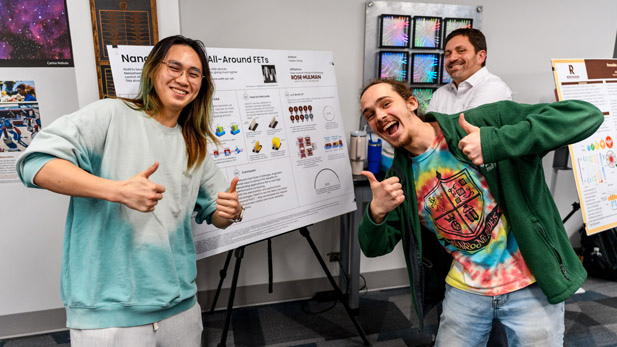
Students in a NanoEngineering course learned to build their own semiconductors in the MiNDS lab and presented research into semiconductor devices at a campus poster session.
Throughout the winter quarter, students in NE 406 and 506: Semiconductor Devices explored tiny tech with big impact.
Semiconductor devices and chips power and control day-to-day electronics in gadgets such as laptops, smartphones, and cars. They function as adjustable electrical pathways and switches. Led by faculty in the Physics, Optical Engineering & NanoEngineering department, the upper-level course taught students about the creation and usage of semiconductor devices, drawing from a variety of academic perspectives and attracting collegians from a multitude of majors.
"It's a growing industry," said Assistant Professor of Physics, Optical Engineering, and NanoEngineering Nicole Pfiester, PhD. "Being able to understand the physics behind how semiconductors work is really helpful if the students’ careers are in any way associated with electronics."
Pfiester taught the course, building a foundation of industry practices and progression in semiconductor applications, including diodes, transistors, solar cells, and LEDs.
"This course has been pretty cool because it's a lot of physics, math. There's optics, there's electrical engineering," said Maria Beloreshka, a senior optical engineering major with computer science, imaging, and Spanish minors and a certificate in semiconductor materials and devices. "It brings together a lot of different engineers from different departments into one class…kind of a melting pot of the different majors."
Pfiester also took care to help students communicate their understanding to a variety of audiences. As a class project, students were tasked with choosing a course concept to explain to a non-expert using a visual aid of their design. Some students developed infographics, PowerPoint slides, or in-person demonstrations. Others took a more unconventional route and created comic strips and card games about semiconductor devices.
Owen Firth, a junior NanoEngineering major, opted to use the opportunity to explain his work to his girlfriend, a student at another institution with no background in engineering.
"I want to go further in my career, where I am the guy who can work with all the engineers, speak their language, and then go speak to the business major…and make sure that the idea is transferred smoothly and effectively," he said.
The students also increased their own processing power by exploring an aspect of semiconductor technology from an analytic, technical perspective and explaining its manufacturing, benefits, and drawbacks. They presented their work in open-house poster sessions to the Rose-Hulman campus on February 17 and 20.
Their knowledge pushed past the theoretical. Throughout the course's co-requisite lab component, students manufactured their own metal-oxide-semiconductor field-effect transistor (MOSFET), which is used for switching or amplifying signals and is the most common transistor in digital circuits. Working in Rose-Hulman's Micro-Nanoscale Device and Systems (MiNDS) cleanroom laboratory, the students utilized state-of-the-art manufacturing methods often reserved for graduate students or professional researchers.
"It can be difficult for students to build confidence in this type of field, especially at the undergrad level, and I think this course helps them to recognize and explore their potential," said Assistant Professor of Physics, Optical Engineering, and NanoEngineering Vishal Saravade, PhD, who instructed the course's lab. "That's a pretty tedious process because you work at a very, very small scale — about the diameter of your hair or even smaller."
In addition to their industry knowledge and readiness, students walked away with a tangible souvenir from the course — a keychain made from the wafers they created.
"We cleaved the wafer with the MOSFETs on it…so now they are on my keys forever," said Beloreshka.
She and her peers carry the keychain wherever they go, a visual manifestation of the nearly invisible technology powering nearly every industry, especially in STEM fields. The lessons learned at Rose-Hulman through courses like NE 406 and 506 open the gate for the students to amplify their impact amidst the ever-changing current of innovation.
Semiconductor devices and chips power and control day-to-day electronics in gadgets such as laptops, smartphones, and cars. They function as adjustable electrical pathways and switches. Led by faculty in the Physics, Optical Engineering & NanoEngineering department, the upper-level course taught students about the creation and usage of semiconductor devices, drawing from a variety of academic perspectives and attracting collegians from a multitude of majors.
"It's a growing industry," said Assistant Professor of Physics, Optical Engineering, and NanoEngineering Nicole Pfiester, PhD. "Being able to understand the physics behind how semiconductors work is really helpful if the students’ careers are in any way associated with electronics."
Pfiester taught the course, building a foundation of industry practices and progression in semiconductor applications, including diodes, transistors, solar cells, and LEDs.
"This course has been pretty cool because it's a lot of physics, math. There's optics, there's electrical engineering," said Maria Beloreshka, a senior optical engineering major with computer science, imaging, and Spanish minors and a certificate in semiconductor materials and devices. "It brings together a lot of different engineers from different departments into one class…kind of a melting pot of the different majors."
Pfiester also took care to help students communicate their understanding to a variety of audiences. As a class project, students were tasked with choosing a course concept to explain to a non-expert using a visual aid of their design. Some students developed infographics, PowerPoint slides, or in-person demonstrations. Others took a more unconventional route and created comic strips and card games about semiconductor devices.
Owen Firth, a junior NanoEngineering major, opted to use the opportunity to explain his work to his girlfriend, a student at another institution with no background in engineering.
"I want to go further in my career, where I am the guy who can work with all the engineers, speak their language, and then go speak to the business major…and make sure that the idea is transferred smoothly and effectively," he said.
The students also increased their own processing power by exploring an aspect of semiconductor technology from an analytic, technical perspective and explaining its manufacturing, benefits, and drawbacks. They presented their work in open-house poster sessions to the Rose-Hulman campus on February 17 and 20.
Their knowledge pushed past the theoretical. Throughout the course's co-requisite lab component, students manufactured their own metal-oxide-semiconductor field-effect transistor (MOSFET), which is used for switching or amplifying signals and is the most common transistor in digital circuits. Working in Rose-Hulman's Micro-Nanoscale Device and Systems (MiNDS) cleanroom laboratory, the students utilized state-of-the-art manufacturing methods often reserved for graduate students or professional researchers.
"It can be difficult for students to build confidence in this type of field, especially at the undergrad level, and I think this course helps them to recognize and explore their potential," said Assistant Professor of Physics, Optical Engineering, and NanoEngineering Vishal Saravade, PhD, who instructed the course's lab. "That's a pretty tedious process because you work at a very, very small scale — about the diameter of your hair or even smaller."
In addition to their industry knowledge and readiness, students walked away with a tangible souvenir from the course — a keychain made from the wafers they created.
"We cleaved the wafer with the MOSFETs on it…so now they are on my keys forever," said Beloreshka.
She and her peers carry the keychain wherever they go, a visual manifestation of the nearly invisible technology powering nearly every industry, especially in STEM fields. The lessons learned at Rose-Hulman through courses like NE 406 and 506 open the gate for the students to amplify their impact amidst the ever-changing current of innovation.